

The most valuable information in the stock market is embedded in the language executives use during earnings calls, when they are under pressure to explain themselves. When you understand this, your entire approach to investing begins to evolve into something far more deliberate and informed.
Earnings call transcripts are widely available and easy to access, which creates the illusion that they offer limited value. Most investors read them casually, focusing on headline numbers or management summaries, and then move on. What they miss is that these calls are one of the few environments where executives must communicate in real time, defend their decisions, and respond to scrutiny from analysts who are actively probing for weaknesses.
That combination creates subtle cracks in the narrative, and those cracks often reveal more than the numbers themselves.
When you learn to read earnings call transcripts with precision, you begin to detect shifts in confidence, emerging risks, and strategic pivots before they fully materialize in financial performance or price action.
This process will help you interpret the right stock signals with depth and consistency and, ultimately, make better decisions.

Why Earnings Call Transcripts Offer a Structural Edge
Most market participants treat earnings calls as backward-looking summaries of financial performance, but that perspective overlooks their real value. These transcripts capture how management teams communicate under pressure, which introduces nuance that does not appear in financial statements or press releases.
Executives prepare extensively for these calls, yet they operate under constraints that make perfect control impossible. They must balance transparency with positioning, acknowledge challenges without amplifying them, and provide guidance without overcommitting. This tension produces subtle inconsistencies in tone, wording, and emphasis that can be systematically analyzed.
At the same time, earnings calls serve as a bridge between past performance and future expectations. Management teams use them to shape how investors interpret results and what they should anticipate next. That forward-looking element often carries more predictive value than the raw financial data.

Professional investors treat earnings call transcripts as behavioral datasets. They analyze how executives communicate, how narratives evolve, and where language diverges from underlying reality.
That shift in perspective transforms a routine document into a high-signal source of investing insight. Here’s how to analyze earnings calls to leverage it.
Step 1: Read Prepared Remarks as Narrative Construction
The opening section of an earnings call is carefully scripted, which leads many investors to underestimate its importance. In reality, this is where management establishes the narrative framework they want the market to adopt.
Instead of focusing only on what is being said, focus on how the story is constructed. Pay close attention to where emphasis is placed, how language is used to frame performance, and which topics receive limited attention.

The most useful way to approach this section is to evaluate three specific dimensions:
What gets emphasized: Strong performance areas tend to be highlighted early and reinforced repeatedly, while weaker areas are often condensed or reframed. This imbalance reflects internal priorities and can reveal where management feels confident or exposed.
Language intensity: Small shifts in wording can signal meaningful changes in sentiment. Describing performance as “strong” or “accelerating” carries a very different implication than calling it “stable” or “in line with expectations.” Tracking these changes across quarters helps you identify sentiment trends before they become obvious.
What is missing: When a previously important metric or segment disappears from the narrative, it often signals underlying weakness. Omissions are rarely accidental, and repeated absence tends to confirm that management is deliberately redirecting attention.
Capturing these patterns consistently requires more than occasional reading. Platforms like MarketAlerts help systematize this process by tracking how emphasis, language, and key themes evolve across earnings calls, making it easier to identify meaningful deviations.
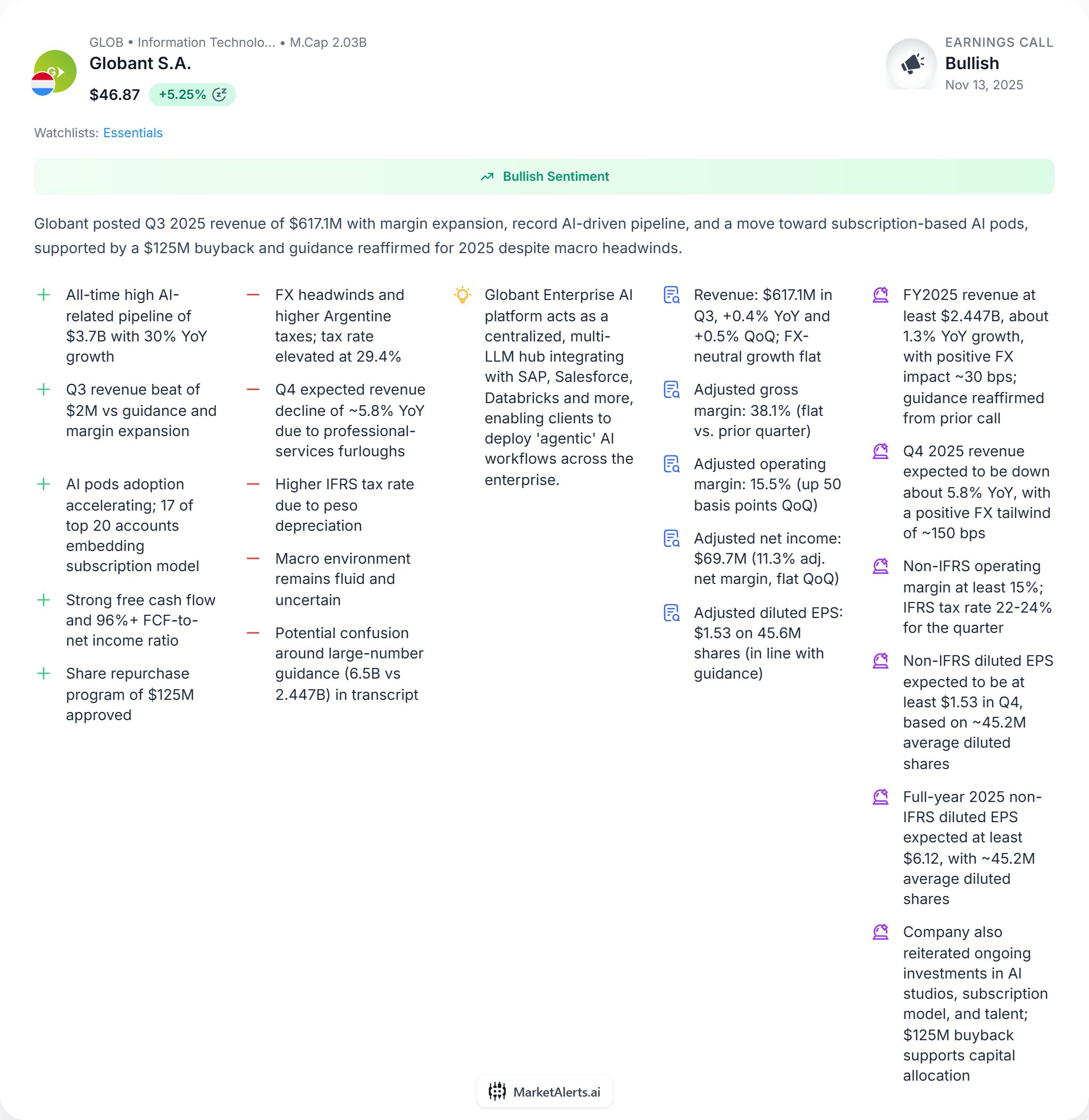
Step 2: Interpret Guidance Through Language
Guidance is one of the most closely watched components of any earnings call, yet most investors reduce it to a numerical range. That approach misses the interpretive layer that professionals rely on to assess credibility and risk.
Management rarely presents guidance without context. They frame it with qualifiers, assumptions, and directional commentary that shape how the numbers should be interpreted. Understanding this framing is essential because it reveals how confident executives are in their own projections.

There are three key elements to focus on when analyzing guidance:
Structure and qualifiers: Phrases that express confidence, caution, or uncertainty provide critical context. A company projecting strong growth while repeatedly emphasizing uncertainty is signaling something very different from one that communicates clarity and conviction.
Precision versus vagueness: Detailed ranges supported by clear assumptions suggest strong visibility into future performance. When guidance becomes more qualitative or directional, it often reflects reduced confidence in forecasting.
Changes relative to prior guidance: The most valuable signal comes from how guidance evolves. Upward revisions paired with confident language often indicate real momentum, while stable or reduced guidance framed defensively can point to emerging risks.
Tracking these nuances across multiple companies is difficult to do manually.
Did you know? MarketAlerts continuously analyzes earnings call transcripts and highlights shifts in financial guidance language, allowing you to focus on interpreting what those changes actually mean.
Step 3: Treat Tone as a Measurable Signal
Tone analysis becomes powerful when it is treated as a structured input. The goal is to identify patterns that can be compared across time, rather than relying on isolated intuition.
Confidence tends to appear through direct, unambiguous statements and a willingness to address both opportunities and risks openly. Caution, by contrast, often shows up through hedging language, indirect phrasing, and repeated references to uncertainty. The balance between these modes provides a real-time view into management sentiment.

Consistency across speakers adds another layer of insight. When executives present a unified tone, it suggests alignment within the organization. When tone diverges, particularly between leadership and financial executives, it can indicate internal uncertainty about the company’s trajectory.
Even in highly controlled communication, emotional signals tend to surface indirectly. Overly complex explanations, defensive phrasing, or subtle shifts in cadence often point to discomfort around specific topics.
Step 4: Use the Earnings Call Q&A Section to Identify Hidden Pressure Points
The Q&A portion of an earnings call introduces unpredictability, which makes it one of the most valuable sections for extracting insight. Analysts are not constrained by the company’s narrative and tend to focus on areas where clarity is lacking or concerns are building.
The dynamic of this section can be broken down into a few critical observations:
Question clustering: When multiple analysts focus on the same issue, it signals that the topic is not fully resolved. Repetition highlights where uncertainty exists within the investment community.
Answer quality: Direct, data-supported responses indicate confidence, while vague or deflective answers suggest that management may be avoiding full transparency. Inconsistencies between answers and earlier remarks often reveal deeper issues.
Follow-up pressure: Follow-up questions occur when initial responses fail to address concerns. Repeated probing on the same topic is a strong indicator that the issue remains unresolved and may carry more weight than management initially suggested.
This section often exposes the gap between management’s narrative and external perception, which is where many of the most actionable signals emerge.

Step 5: Track Narrative Evolution Across Quarters
A single earnings call provides limited context. The real advantage comes from understanding how narratives evolve over time and connecting those changes to underlying business developments.
Management language shifts gradually as conditions change. A company that consistently emphasizes growth may begin to focus more on efficiency, margins, or cost control as its environment evolves. These transitions are rarely abrupt, which makes them difficult to detect without structured comparison.
Tracking how key themes, risks, and priorities develop across multiple quarters, helps you build a narrative timeline that reflects the company’s trajectory. This allows you to anticipate strategic shifts before they become fully visible in financial results or market expectations.

Maintaining this level of analysis manually is both time-intensive and inconsistent. MarketAlerts simplifies the process by continuously analyzing earnings call transcripts and highlighting meaningful changes in language, tone, and focus areas, enabling you to identify patterns with greater speed and clarity.
Step 6: Connect Language Signals to Market Behavior
Earnings call analysis becomes actionable when it is connected to how the market responds. Prices move based on changes in expectations, which makes the interpretation of language particularly valuable.
Your objective is to identify discrepancies between what management is signaling and what the market appears to be pricing in:
When tone improves while a stock underperforms, it can indicate that positive change has not yet been recognized.
When tone deteriorates despite strong price performance, it may signal that risk is building beneath the surface.
How MarketAlerts Scales Earnings Call Analysis
The framework outlined above is powerful, but applying it consistently across a large universe of companies presents a practical challenge. The volume of earnings call transcripts makes manual analysis difficult to sustain with the level of depth required.
Here’s where MarketAlerts gives you an advantage. With it, you can automate the most resource-intensive components, like scanning transcripts across the market, detecting changes in tone and language, identifying unusual communication patterns, and tracking narrative shifts over time.

This allows you to:
Monitor thousands of earnings calls without manual effort.
Detect subtle changes in sentiment and guidance language.
Spot emerging patterns before they become widely recognized.
Focus your time on interpretation and decision-making rather than data collection.
The most relevant advantage is consistency: With MarketAlerts, you can gain a clearer and more reliable view of what is actually changing beneath the surface.
Turning Earnings Call Transcript Analysis Into an Investment Edge
Reading earnings call transcripts like a professional analyst requires a shift in perspective. Instead of treating them as static reports, you begin to see them as dynamic expressions of confidence, uncertainty, and strategic intent.
As you apply this framework, patterns begin to emerge. You start to recognize when sentiment is improving, when risks are quietly building, and when management is repositioning the narrative in subtle but meaningful ways. These insights accumulate over time, allowing you to anticipate change rather than react to it.

When this process is supported by advanced tools like MarketAlerts, your ability to act on these signals becomes significantly more precise. You are no longer limited by how much information you can manually process, and you gain access to a broader set of opportunities that would otherwise remain hidden.
The advantage compounds quietly at first, then all at once. What begins as a more careful reading of language evolves into a sharper instinct for recognizing inflection points before they become consensus. You stop relying on headlines and start trusting structured interpretation, where every shift in tone, every change in emphasis, and every unanswered question becomes part of a bigger signal.
Over time, this discipline separates noise from meaning with increasing precision, allowing you to move earlier, with more conviction, and with a clearer understanding of what is actually changing beneath the surface.