
How One Perfectly Timed Product Launch Created an Opportunity Most Investors Never Saw Coming
Have you ever heard of Hansen’s Natural Corporation? Once a small food and beverage company struggling to scale and trading under the radar, it skyrocketed to become one of the top-performing stocks of the century. And it was all because of one simple, yet critical signal most investors missed.
It appeared in a product launch that completely changed how the company competed and who it served. In 2002, Hansen’s introduced Monster Energy, a bold, oversized, aggressive drink aimed at a culture that the market didn’t yet recognize as profitable.
Nothing about Monster looked like the beginning of a generational wealth-creation story. It was a beverage launch from a small, unremarkable company that most investors had already mentally filed away as irrelevant.
That is precisely why it mattered.
Because the greatest opportunities in markets rarely arrive with clarity or consensus. They arrive quietly, disguised as products that feel trivial, launched into categories that seem crowded, by companies the market believes it already understands.
Hansen’s evolution into Monster Energy followed this exact pattern, rewarding investors who recognized the signal early and leaving everyone else with the thought of what might have been. And it reveals exactly why one simple product launch can create the kind of returns most traders only dream about.
Now, here’s what you should care most about: opportunities like this still appear today. With the right approach, you can not only identify them but position yourself to capture them before the market catches on.
In this article, you’ll learn how to spot these early signals, distinguish the ones with the highest potential, and act decisively to turn them into meaningful investment outcomes.
An Overlooked Company With No Embedded Expectations
To understand why Monster Energy created such an outsized investment opportunity, you have to start with how little the market expected from the company behind it.
Hansen’s Natural Corporation had been operating since the 1930s, selling juices and sodas with limited geographic reach and no strategic edge. It was stable, modestly profitable, and strategically boxed in by beverage giants whose scale made meaningful competition seem unrealistic. There was no growth narrative attached to the stock, no innovation premium, and no reason for investors to monitor it closely.
By the late 1990s, Hansen’s was effectively invisible to the market. It wasn’t controversial, exciting, or declining fast enough to matter. It simply existed, and for investors, that made it irrelevant.
That lack of expectations is important. It created the conditions where a single, well-timed strategic signal could matter enormously.
Red Bull Proved Demand, but Left a Large Market Untouched
In the late 1990s, everything changed.
Red Bull’s arrival in the U.S. didn’t just introduce a product; it validated a new consumer behavior. A small, premium-priced can positioned around energy, focus, and performance created a category that hadn’t previously existed.
Most competitors responded by copying the surface features. They used similar cans, claims, and branding. Almost all of them failed, because they focused on the product rather than the positioning.
But Hansen’s noticed something others didn’t. Red Bull’s appeal was narrow by design. Its polished, premium image resonated strongly with one type of consumer, but it excluded many others. Large segments of the market didn’t see themselves reflected in the brand at all.
And that was exactly where Monster Energy saw the opportunity of a lifetime.

Monster Energy: The New Product That Signaled a Strategic Repositioning
When Monster Energy launched in 2002, it wasn’t an incremental extension of Hansen’s product line. It was a clear break from the company’s past.
The oversized can, aggressive branding, bold flavors, and pricing communicated a deliberate shift in target audience and competitive strategy. Monster wasn’t trying to outperform Red Bull on refinement or prestige. It was positioning itself as the opposite.
For investors, this mattered because the launch revealed intent. Hansen’s was no longer behaving like a small legacy beverage company trying to survive. It was attempting to take the market by storm, owning a segment of a rapidly forming category by aligning with a different identity and culture.
Monster wasn’t competing on energy content. It was competing on who the product was built for.
The Earliest Trading Signals Are Not Easy to Spot
In the years following the launch, Monster didn’t immediately stand out in earnings reports or analyst coverage. What it did instead was embed itself deeply into specific communities before they were commercially obvious.
The brand showed up in action sports, combat sports, gaming, and subcultures that valued authenticity and rejected traditional advertising. Monster didn’t market itself to these groups; it integrated with them.
That distinction is critical. When a product becomes part of identity rather than a functional purchase, growth dynamics change. Adoption spreads organically, loyalty strengthens, and pricing power improves over time.
These signals were visible to anyone watching consumer behavior closely, but they didn’t translate into clean financial narratives early on.
Market Recognition Came Only After the Advantage Was Established
Monster was easy to dismiss. Beverage markets are competitive, consumer tastes change, and youth-oriented brands often fade. Those assumptions kept many investors anchored to the past.
But Monster’s position kept strengthening. Distribution expanded, margins improved, and market share grew steadily powered by its new star product. By the time Coca-Cola acquired a significant stake in the company, the strategic advantage was already established.
The investment wasn’t about near-term revenue. It was an acknowledgment that Monster had built durable relevance within a category that still had room to grow globally.
At that point, the opportunity was widely recognized
The Actual Lesson: Market Signals That Redefine a Company’s Trajectory
Monster Energy is not an investing lesson about beverages. It is a lesson about recognizing stock signals that indicate a company is no longer operating within the constraints of its past.
Most investors anchor on what a company has been. Revenues, margins, market share, peer comparisons. Those are backward-looking by design. The highest-return opportunities tend to emerge when a company takes an action that changes what it can become, and the market has not yet adjusted its expectations.
New product launches are one of the clearest expressions of that shift. Not all of them matter, but some reveal a change in ambition, audience, and strategic direction. Monster Energy was one of those cases. It signaled that Hansen’s was no longer content to compete as a small legacy beverage brand, but intended to own a meaningful position in a fast-growing category with global potential.
Start tracking new product launches and more key trading signals with MarketAlerts.
For traders and investors, it’s critical to understand that when a product launch redefines who a company is built for and how it plans to compete, future returns are often driven by that decision long before they appear in the financials. The signal comes first. The numbers follow later.
Why This Stock Signal Still Creates Opportunity for Investors Today
This dynamic did not disappear with Monster Energy. If anything, it has become more common.
Companies pivot more frequently. New categories form faster. Product launches, feature rollouts, and strategic updates often carry more informational value for investors than earnings calls, especially in the early stages of a transition.
Why aren’t more investors monitoring these signals, then? Simply put, because they are buried under an overwhelming volume of noise.
Traders who rely solely on price action or lagging fundamentals often encounter these opportunities only after the market has already started repricing them. By then, the risk-reward profile has changed.
This is where structured signal tracking becomes an advantage. And that is exactly why MarketAlerts exists.
How You Can Actually Use These Signals to Get Ahead
If you’re trying to catch opportunities like Monster Energy early, the problem isn’t knowing that signals matter. The problem is spotting the right ones consistently, without drowning in noise or reacting after the market has already moved.
Instead of scanning headlines, earnings calendars, and press releases manually, you can use MarketAlerts to do it for you. All you have to do is tell the system what kinds of signals you care about and let it surface them for you.
The goal is to maximize awareness: you want to know when something meaningful changes, while there’s still time to think.
The Exact Stock Signals You Can Track
One of the key advantages of MarketAlerts is that it offers multiple options, which translates into a customizable, flexible experience you can adjust to your own strategy and preferences.
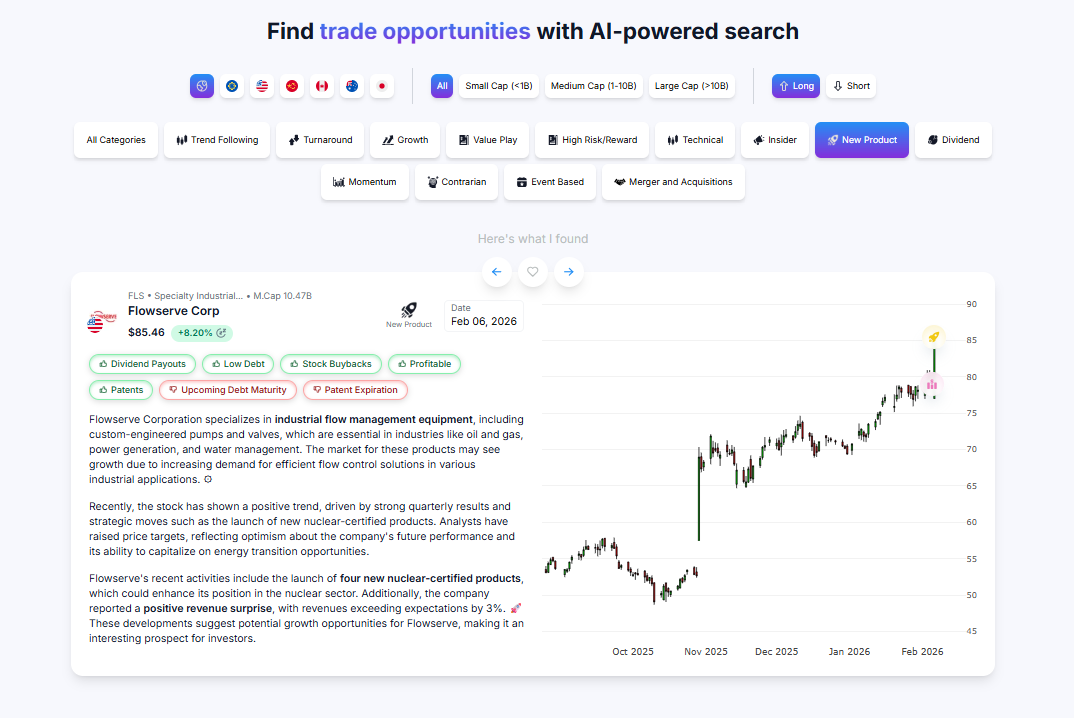
You can set trading alerts around new product launches and major product updates, which are often the earliest indicators of a shift in strategy. This includes brand-new products, major feature rollouts, platform expansions, and launches that move a company into a new category or audience.
You can also track stock signals from strategic company updates such as partnerships, acquisitions, leadership changes, or meaningful shifts in how management talks about the business. These are often early signs that the company’s priorities have changed, even if the numbers haven’t yet.
On top of that, you can monitor confirmation signals like insider trading, institutional activity, and analyst behavior. On their own, these can be misleading. Combined with a product or strategy signal, they help you judge whether informed participants are taking the move seriously.
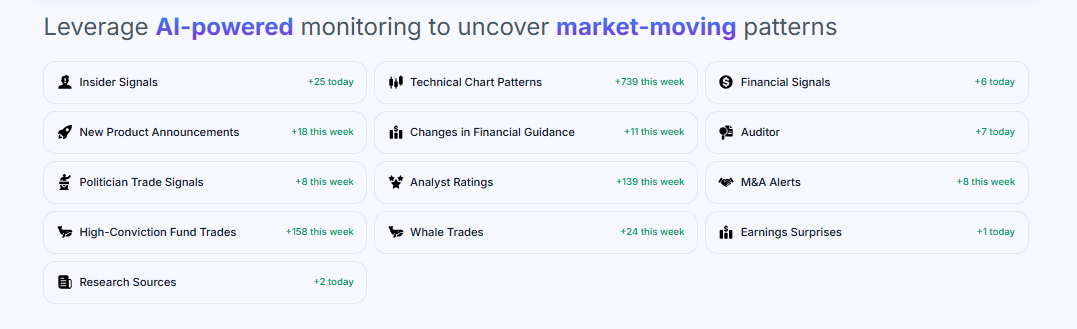
The point is not to react to everything. It’s to notice when multiple signals start pointing in the same direction.
How Product-Launch and Other AI Stock Alerts Work
Interested in setting up a signal-based investment strategy? Here’s how this plays out in practice.
If you are using MarketAlerts, you can set trading alerts for the companies, sectors, or themes you care about. When a new product launch or major update is detected, you receive a message or notification that not only gives you information, but also context: how this launch differs from what the company has done before and why it may matter strategically.
This is the difference between “A company just launched a new product” and “A company just repositioned itself toward a higher-growth audience.” One is noise, the other is an actual trading signal.
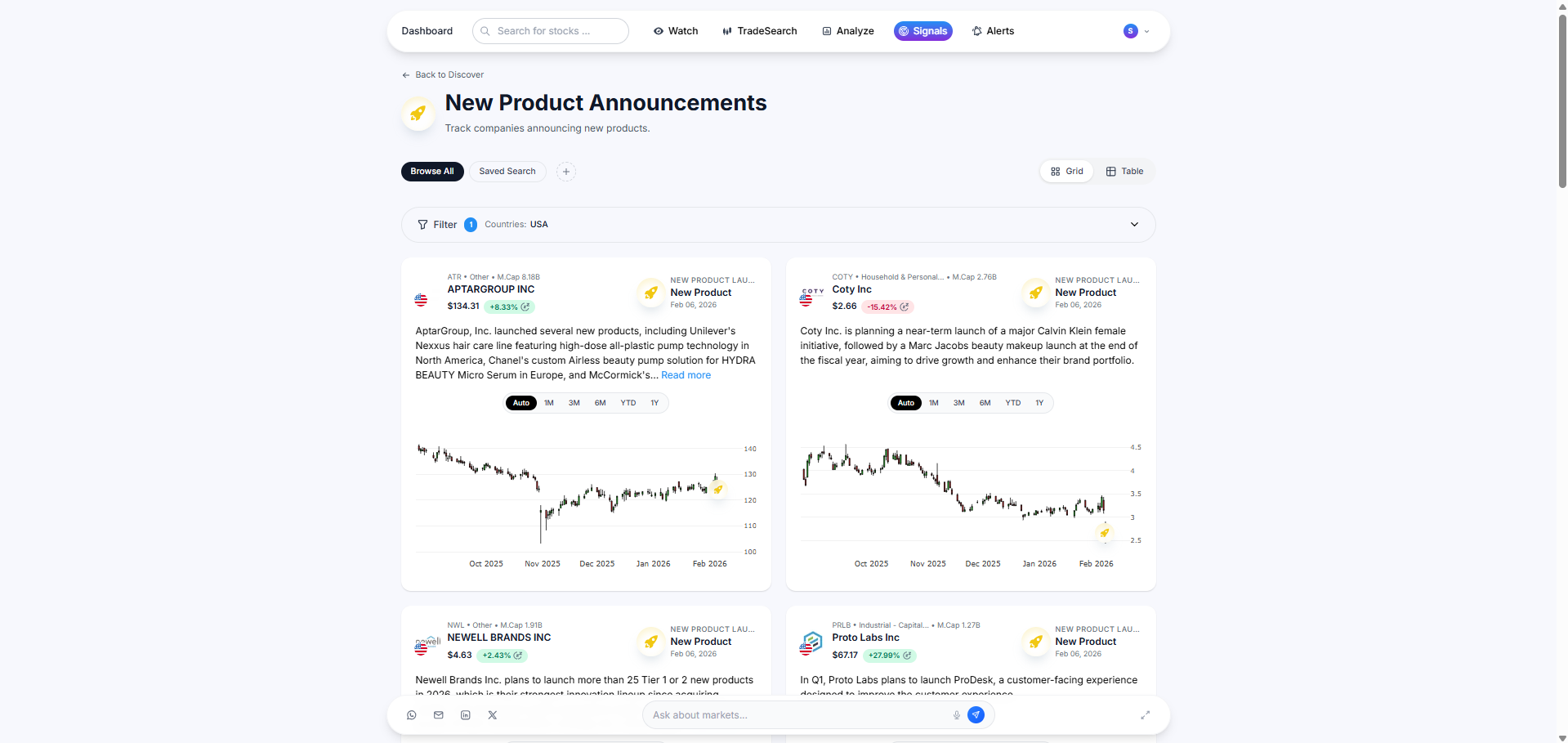
That context buys you time and positions you ahead of the market. You get the absolute privilege to think about market size, positioning, and competitive response. To decide whether this is something you want to track closely, start researching, or ignore entirely.
That window is where most investors lose their advantage. Using these AI stock market signals, you can keep it.
How You Turn AI Trading Alerts Into Better Trades
You don’t use these alerts to trade immediately. You use them to build conviction earlier than the market.
First, you identify the signal. A launch that changes how the company should be viewed, for example. Then you watch for follow-through or confirmation: adoption, management commentary, partnerships, capital flows. Only then do you decide how and when to act.

This approach keeps you out of impulsive trades and puts you into asymmetric ones. You’re positioning in the market while uncertainty is still high and expectations are still low.
That’s exactly where Monster Energy sat in 2002.
Why This Gives You an Advantage Over Most Investors
Most investors still rely on backward-looking indicators: earnings beats, revenue acceleration, analyst upgrades. These are excellent, high-quality stock signals, but the market often moves before they show up, which means the chance to capture outsized returns has already passed.
Indeed, the best investments come from finding market shifts and changes in trend before they are priced in. That is why MarketAlerts focus on underlying, often hidden stock signals that surface these shifts and allow you to spot and capture opportunities like Monster Energy before anyone else..
In other words, these stock signals make sure you don’t miss the moment when a company quietly stops being what it was and starts becoming something else.
That’s the moment Monster Energy investors noticed early. And that’s the moment you can catch next. All you have to do is start focusing on the right signals. Start now with MarketAlerts.