
How do you decide which stocks are worth your attention? Do you rely on gut instinct, charts, or company reports? Every investor hopes they have the ability to spot opportunities before the rest of the market reacts and to make decisions with confidence instead of guesswork.
Many believe it’s possible to anticipate market moves, and in a sense, they’re right. Every price movement happens for a reason. Learning to recognize those reasons (which we call signals) before the broader market reacts can give you a massive advantage.
These signals can take many forms: technical patterns, insider activity, research updates, fundamental shifts, or any factor that suggests a stock may be about to move. Understanding and interpreting them is what separates reactive investors from those who act with insight.
Now, finding these signals is not that easy. The market is flooded with information, and separating the signals from the noise requires constant attention, excellent pattern recognition, and hours of data analysis.

That’s why MarketAlerts developed signal-based trading alerts: a system that leverages AI to monitor the market, process information in real-time, and pick the signals that matter to you to help you make smarter investment decisions.
In this article, you will learn to create these smart alerts and how to integrate them into your investment strategy. But first, let’s go over the basics.
What Are Signal-Based Trading Alerts?
Signal-based trading alerts are designed to go beyond traditional price notifications. Instead of reacting to a stock’s movement after it happens, they focus on the underlying events and patterns that often precede significant market moves. This allows investors to act with insight rather than respond to noise.
These alerts identify meaningful market activity, including technical shifts, company developments, insider transactions, and changes in market sentiment. They can integrate multiple stock signals and prioritize the events most likely to affect a stock’s trajectory, helping you focus on opportunities that matter.
Unlike conventional price alerts, which can trigger on minor fluctuations or routine volatility, signal-based alerts provide context and relevance. And when used correctly, they are an extremely powerful tool for investors to make informed decisions, respond strategically, and maintain focus on high-probability opportunities rather than reacting impulsively to short-term swings.

Can Smart Trading Alerts Transform Your Investment Strategy?
Many investors see alerts as notifications, but they can be much more than that. They can help you identify meaningful stock signals early, spot opportunities before others, and make decisions with confidence at the right time.
This is the real potential of AI-powered smart alerts:
Proactive Decision-Making: Receive alerts when underlying conditions suggest a stock may move, rather than after it happens.
Reduced Noise: AI analysis filters out insignificant price fluctuations, delivering only meaningful stock signals.
Enhanced Efficiency: Monitor dozens or hundreds of stocks without manually scanning charts or news feeds.
Actionable Context: Alerts include details about why the signal triggered, from technical patterns to insider activity or research updates.
These advantages let investors act decisively while maintaining a disciplined, signal-driven strategy rather than chasing price swings.
Now, let’s dive into how exactly you can start leveraging the power of smart alerts.

How to Create Smart Trading Alerts That Fit Your Strategy
Designing alerts that align with your investment approach requires focusing on three elements: the signal, the conditions, and the context.
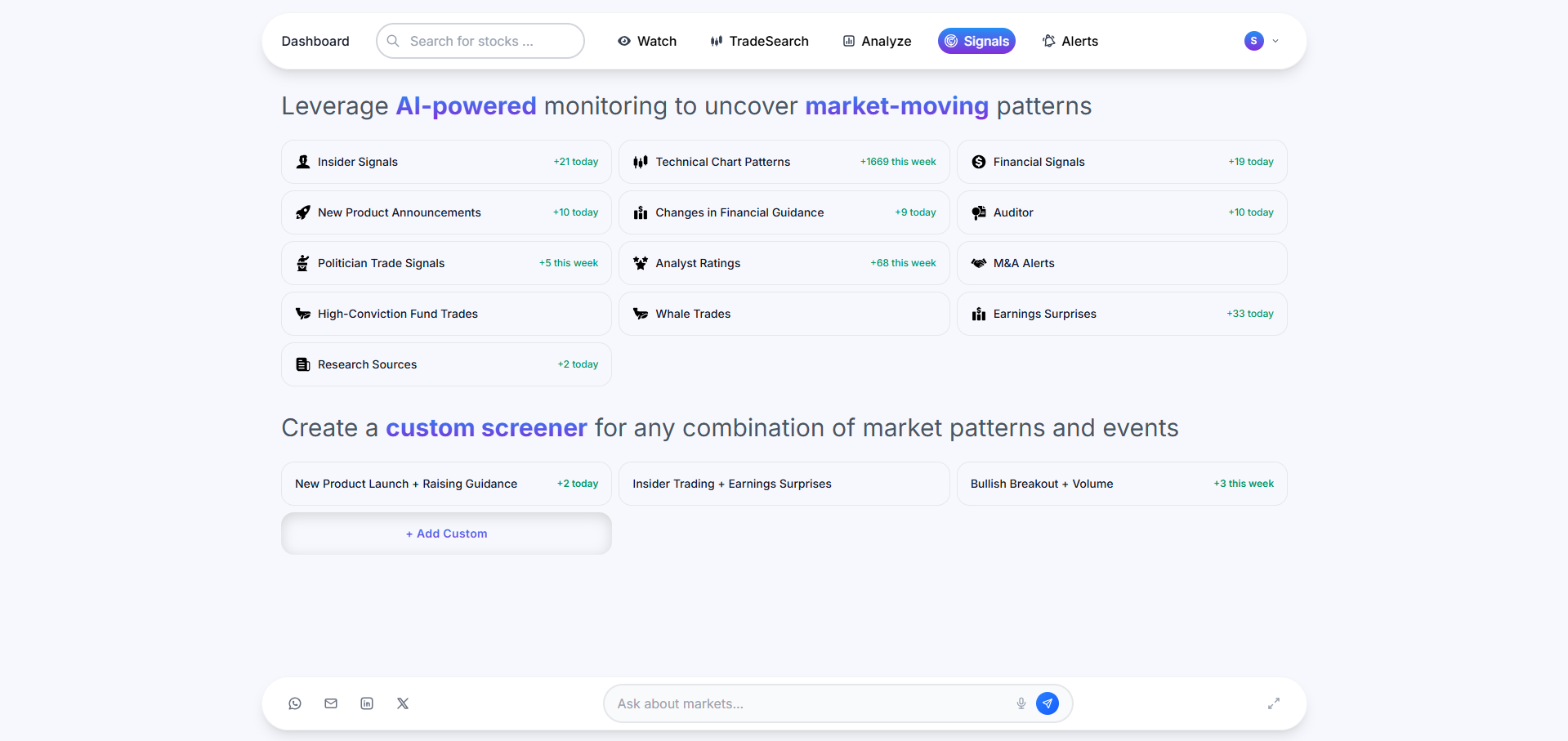
1. Identify the Stock Signals That Matter
Start by determining which signals align with your strategy.
For technical traders, this might include breakouts, trend reversals, or momentum indicators. These signals are generally found in stock chart patterns, but finding them requires hours of technical analysis.
For fundamental investors, signals could include earnings surprises, regulatory approvals, or revenue milestones. For growth or value investors, insider buying or analyst upgrades may be particularly relevant as well.
MarketAlerts lets you select the signals that matter to your strategy and continuously monitors the market, notifying you whenever those conditions are met.
2. Include Context to Make Alerts Actionable
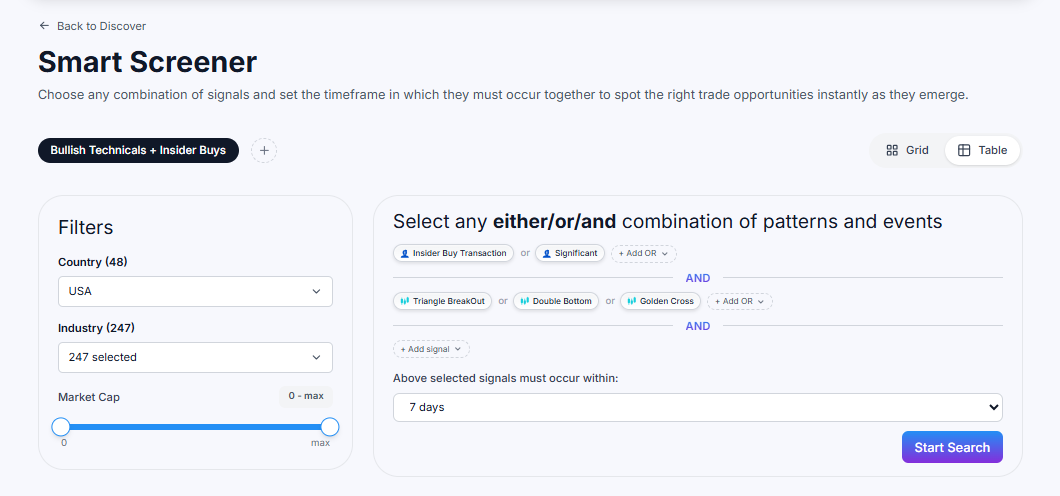
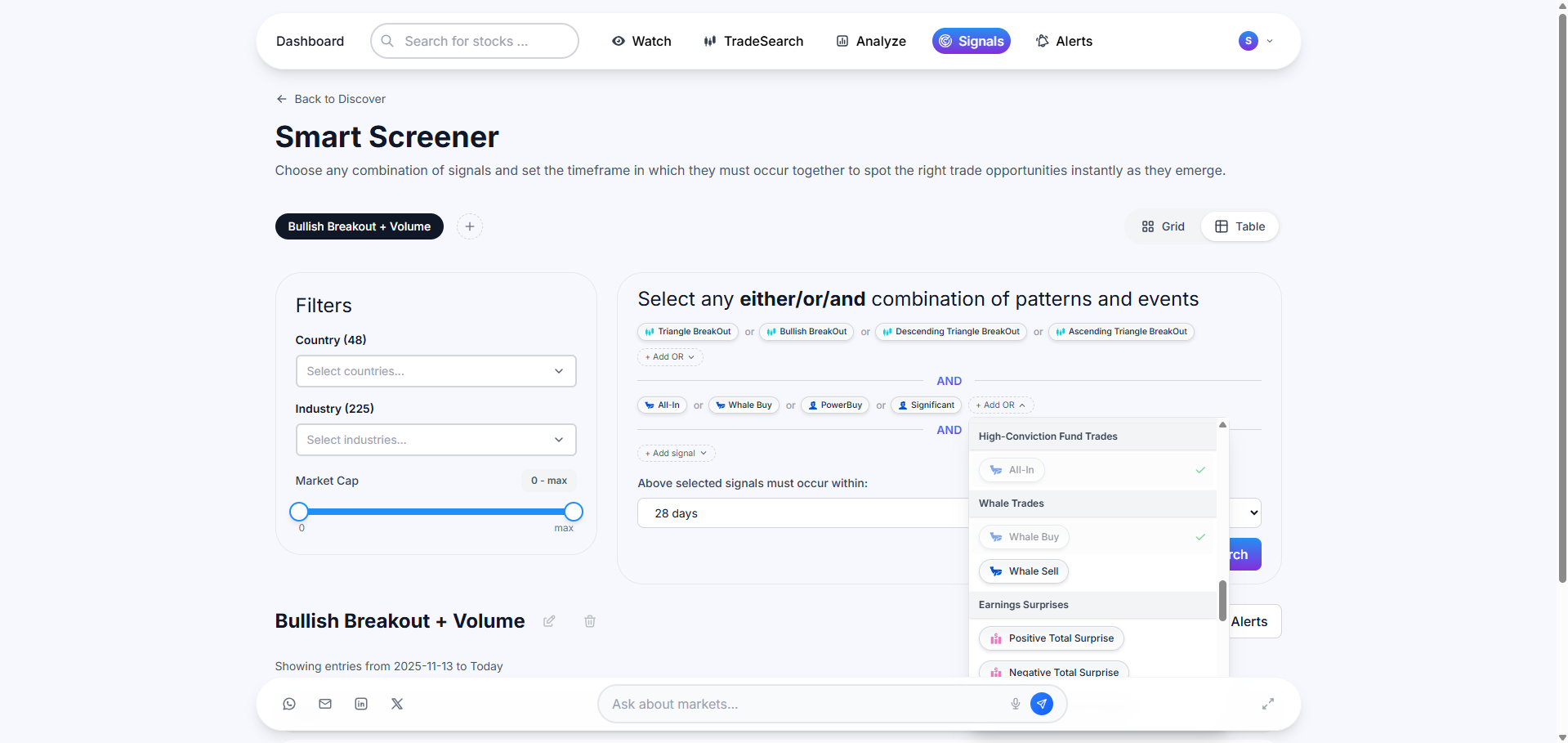
Context transforms a signal into actionable insight. A stock forming a bullish pattern is noteworthy, but knowing whether this coincides with insider buying, analyst upgrades, or a sector rotation is what makes it meaningful.
MarketAlerts automatically adds context to each alert, showing the underlying signal, contributing factors, and potential implications. When multiple signals are combined, this detail provides a complete view of what is happening with a stock.
One signal may highlight a potential trend, while another can confirm it, giving you the confidence to act. Conversely, alerts can also prevent poor trades by filtering out opportunities that don’t meet all your selected criteria, helping you avoid fakeouts.
Another key consideration is risk management. Alerts can be designed to notify you of downside risk triggers, such as a stock breaking below support or a sudden surge in volatility. These notifications act as early warning systems, giving you the chance to reassess exposure or adjust stop-loss levels before losses escalate.
3. Choose the Right Alert Type
MarketAlerts offers four complementary alert types to cover all stages of your strategy:
Stocks Alerts: Monitor a specific stock for any signal that aligns with your strategy.
Watchlist Alerts: Track a group of selected stocks, receiving notifications when any position generates a relevant signal.
Screener Alerts: Define the signals you want to capture and receive alerts when any stock in the market matches them. Multiple screeners can run simultaneously.
Research Alerts: Receive notifications whenever a respected market research publication releases a report or update relevant to your investments.
Each alert type targets a different stage of the investment process, from discovering opportunities to monitoring active positions and tracking institutional insights.
Remember: you can also create and activate multiple alerts simultaneously.
Integrating MarketAlerts Into Your Strategy
Smart alerts are most effective when integrated into a structured workflow. They aren’t just triggers for action, but can guide your entire investment process.
Indeed, embedding these trading alerts into your strategy, you turn scattered data into a coherent system that supports faster, more confident, and better-informed investment decisions.
To make the most of signal-based alerts, consider how they can be applied across different stages of your strategy:
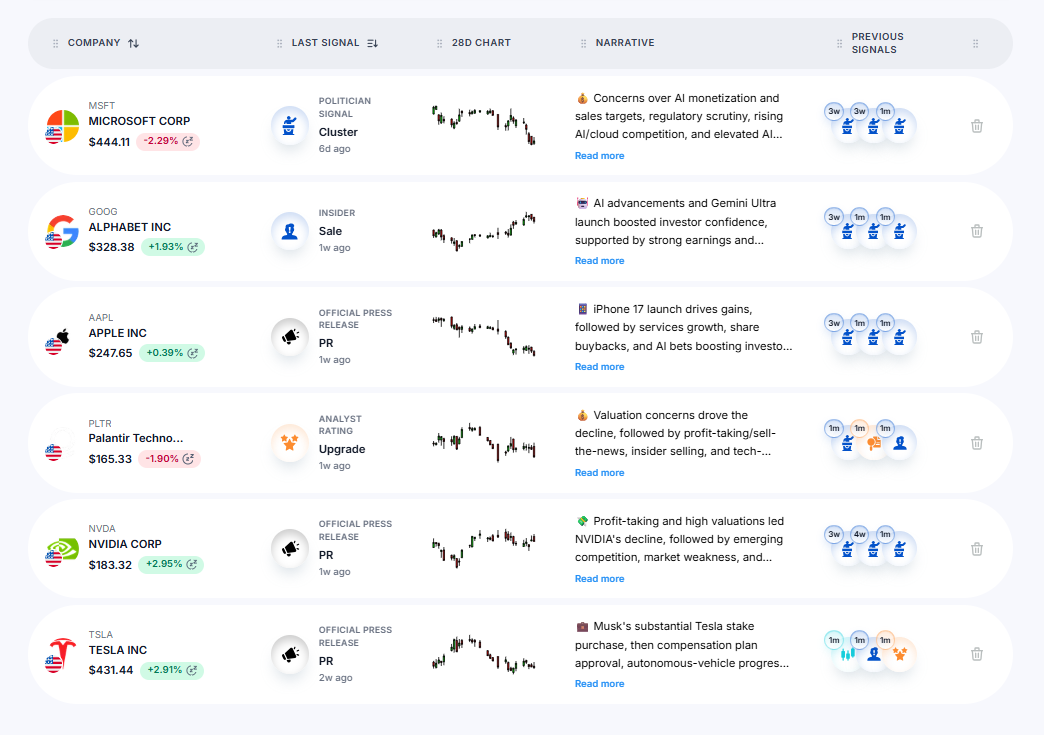
Discover Opportunities: Screener alerts scan the market for stocks that meet your predefined signal criteria. This allows you to identify potential trades systematically rather than relying on chance or manual screening.
Monitor Selected Stocks: Once you have high-conviction candidates, add them to a watchlist for ongoing signal tracking. This ensures you stay informed about developments without needing to constantly check charts or news.
Track Active Positions: When capital is deployed, activate stock alerts to receive real-time notifications about any changes or emerging signals. This helps you stay ahead of trends and manage risk.
Stay Informed: Research alerts provide updates from institutional publications and other credible sources, giving you context that can validate your analysis or highlight potential risks.
Using alerts at every stage, from discovery and monitoring to active management and research integration, creates a disciplined, signal-driven workflow that reduces noise and improves decision-making. The system transforms raw data into actionable intelligence, helping you anticipate market movements, respond quickly, and maintain a consistent, structured approach to investing.


How to Make the Most of Smart Trading Alerts
Smart trading alerts provide the most value when they are intentional. Without a clear framework, alerts can quickly turn into noise: constant notifications that distract rather than inform. The goal is not to receive more signals, but to receive the right signals at the right time, aligned with your strategy and decision-making process.
To extract real value, alerts must be structured, reviewed, and refined with discipline. The following best practices help ensure your trading alerts remain actionable, relevant, and integrated into your investment process rather than becoming background clutter.
Prioritize Relevance Over Quantity: Too many alerts can overwhelm and reduce effectiveness. Focus on signals that align closely with your investment strategy.
Regularly Review and Adjust: Markets evolve. Periodically update your alert criteria to reflect changes in volatility, sector performance, or personal risk tolerance.
Combine Signals: Use a combination of technical, fundamental, and sentiment indicators to create alerts that are more robust and less prone to false positives.
Leverage Multiple Channels: Configure alerts via email, app notifications, or dashboards to ensure you receive information in real time, wherever you are.
Test and Refine: Use historical data to backtest your alert criteria. This helps identify the most predictive signals before relying on them in live trading.
Following these principles ensures that your alerts remain actionable and integrated with your investment decisions, rather than creating distractions or unnecessary noise.

The Benefits of Smart Alerts for Investors
Markets move continuously, but attention does not. Investors are forced to choose between constant monitoring and the risk of missing critical developments. Smart alerts solve this tradeoff by filtering vast amounts of market data into timely, decision-ready signals.
When structured properly, alerts become more than notifications. They act as a systematic layer of oversight, helping investors stay informed, disciplined, and proactive without being overwhelmed. The following benefits illustrate how smart alerts strengthen both performance and process.
Time Efficiency: They eliminate the need for constant monitoring of multiple stocks and news sources.
Informed Decision-Making: Alerts deliver context-rich insights, enabling faster, more confident trading decisions.
Early Opportunity Detection: By notifying investors of emerging trends or unusual activity, alerts provide a potential advantage over other market participants.
Risk Mitigation: Timely notifications about adverse price movements or volatility spikes allow for proactive risk management.
Strategy Consistency: Alerts support a disciplined approach to investing, ensuring actions align with predefined strategies rather than reacting to emotion.
Ultimately, smart alerts bridge the gap between market data and decision-making, transforming passive monitoring into an active, informed approach.


Choosing the Right Platform for Smart Trading Alerts
Smart alerts are only as effective as the system behind them. MarketAlerts is built specifically to surface high-signal events across technical patterns, fundamental shifts, insider activity, analyst actions, and corporate developments, all in real time.
Alerts can be fully customized around your watchlists, portfolio holdings, specific preferences, and strategic conditions, ensuring that what you receive is directly aligned with how you invest.
Speed and accuracy are critical. MarketAlerts is designed to deliver actionable signals without delay, allowing you to respond while opportunities are still developing, not after the move has already happened.
The result is a system that integrates directly into your workflow, helping you stay disciplined, consistent, and ahead of the market.

Invest Smarter With AI Stock Alerts
The advantage no longer goes to the investor who consumes the most information. It goes to the one who receives the right information at the right moment and acts with clarity. Smart trading alerts are designed for exactly that.
When your alerts are aligned with your strategy, filtered for relevance, and delivered in real time, they become a structural advantage. In an environment where price moves are triggered by earnings surprises, insider transactions, analyst revisions, and technical breakouts within minutes, precision is absolutely necessary.
MarketAlerts is built to provide that precision.
If you want your alerts to be more than notifications, start using MarketAlerts and experience how structured, AI-driven signals can transform the way you monitor and act on the market.