
Investing has changed. While you analyze a single chart, algorithms are scanning the entire market, identifying mispricings, and positioning in seconds. Learning how to build high-performing trading strategies with AI is no longer optional for investors who want a durable advantage.
Artificial intelligence can process vast amounts of market data, detect patterns invisible to the human eye, and generate timely, actionable signals. It transforms fragmented information into structured insight. If you’re not using this technology for your investments, you’re already behind.
In this article, we break down a practical, step-by-step framework on how to build high-performing strategies with AI, highlighting practical ways to use stock signals, trading alerts, and automated stock market analysis to identify opportunities, manage risk, and improve returns.

Key Advantages of Using AI for Investing
AI is a high-powered analytical engine designed to process massive datasets, uncover hidden correlations, and generate probabilistic insights at a scale no human can match.
In practical terms, this means identifying unusual price behavior, shifts in sentiment, emerging technical structures, or fundamental inflection points long before they become obvious.
One of its most powerful applications is the generation of structured stock signals that translate complex data into actionable information.
These AI-driven stock signals can span technical and fundamental dimensions, from momentum breakouts and volume surges to earnings surprises, insider transactions, and material news events. When monitored in real time and delivered through precise and smart trading alerts, they give investors a measurable timing advantage.

Beyond signal generation, AI also enables continuous and autonomous market surveillance. Instead of manually reviewing charts and reports, investors can rely on automated systems to scan thousands of securities, filter out noise, and surface high-probability investment opportunities.
This blend of speed, scale, and analytical precision is what makes AI a decisive component in building effective investment strategies.
Now, let’s go over the practical steps on how to build high-performing trading strategies with AI.
Step 1: Define Your Investment Strategy Goals
Every effective trading strategy begins with clarity. What are you trying to achieve? Are you looking for short-term gains through momentum trading, or are you aiming to identify longer-term growth opportunities? The answer determines the signals you monitor, the type of stock signals you prioritize, and how you structure your investing workflow.
For instance, a short-term strategy may focus on real-time trading alerts and technical chart pattern signals like breakouts or trend reversals. Here, stock price alerts are critical, allowing you to act as soon as a potential move is detected.
Conversely, a long-term growth strategy might rely more heavily on AI stock market analysis, monitoring fundamental trends, earnings patterns, and industry developments to identify companies poised for sustained growth.

Defining your goals also helps determine your risk management approach. High-frequency trades may require tighter stop-losses and rapid response, while long-term strategies can accommodate more gradual price movements.
In any case, having clear objectives helps you apply AI investment tools in a way that aligns with your investment priorities and preferences, producing stock signals and trading insights that are actionable and relevant.
Step 2: Collect and Organize Data
Every AI-driven trading strategy is only as strong as the data behind it. The real advantage is not the algorithm itself, but the depth, accuracy, and organization of the data it is built to analyze.
The challenge is in the operational costs: collecting, cleaning, structuring, and standardizing these inputs in a consistent format is a complex and resource-intensive task. And in live markets, it must also happen in real time. If the data is delayed or incomplete, the insight loses value, because the opportunity may already be gone.
This is precisely where specialized AI platforms create leverage: MarketAlerts was built to address this bottleneck. Its integrated AI agent continuously consolidates diverse market data sources, structures them into actionable formats, detects embedded stock signals, and generates trading alerts designed for immediate decision-making.
Instead of assembling the pipeline yourself, the system delivers organized intelligence ready to use.
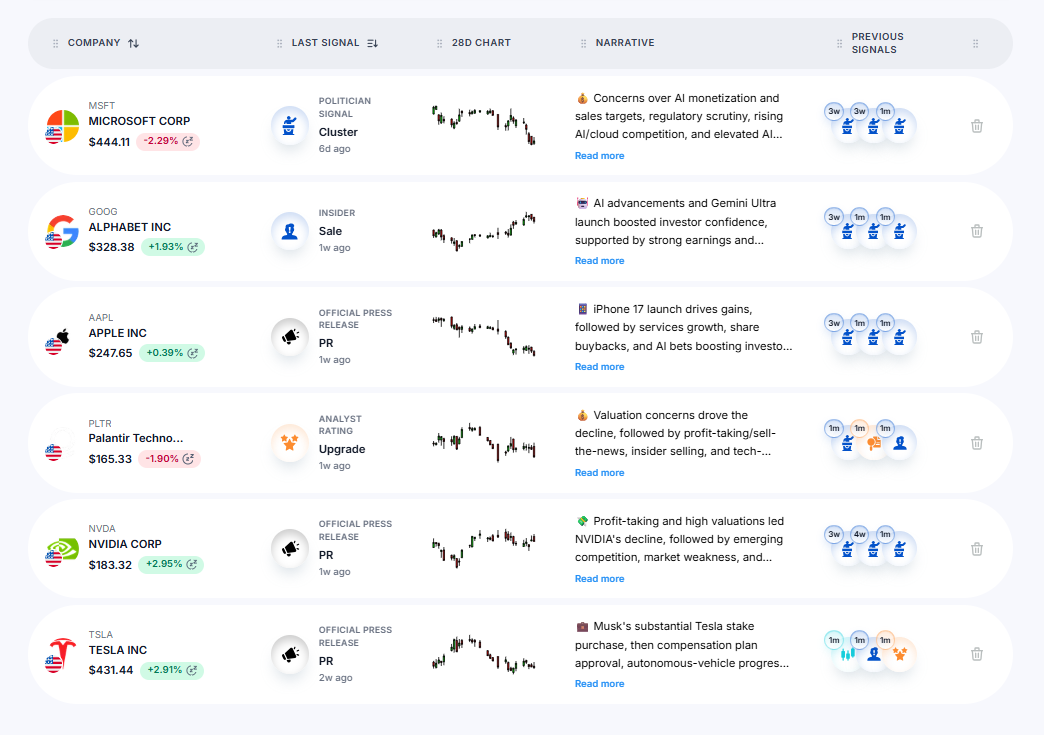
How Exactly Does MarketAlerts Find Key Stock Signals?
Well-structured data enables AI to surface patterns, correlations, and anomalies that would be nearly impossible to monitor manually across thousands of securities. Structure also determines usability: a robust system categorizes signals by type, timeframe, and relevance, ensuring alerts are coherent rather than overwhelming. Without disciplined organization, even advanced models can produce noise or conflicting outputs.
MarketAlerts scans multiple data sources, consistently collecting and analyzing information that includes:
Historical stock prices and technical chart patterns.
Real-time market price movements.
Earnings reports and financial statements published by companies.
News events and press releases.
Institutional investor activity and insider trades.
Social sentiment and broader economic indicators.
Each dataset captures a different dimension of market behavior. Together, they form the foundation for meaningful signal generation.
In AI-driven trading, data is the foundations for your strategy's architecture. The way it is gathered and organized ultimately defines the quality of the strategy built on top of it.
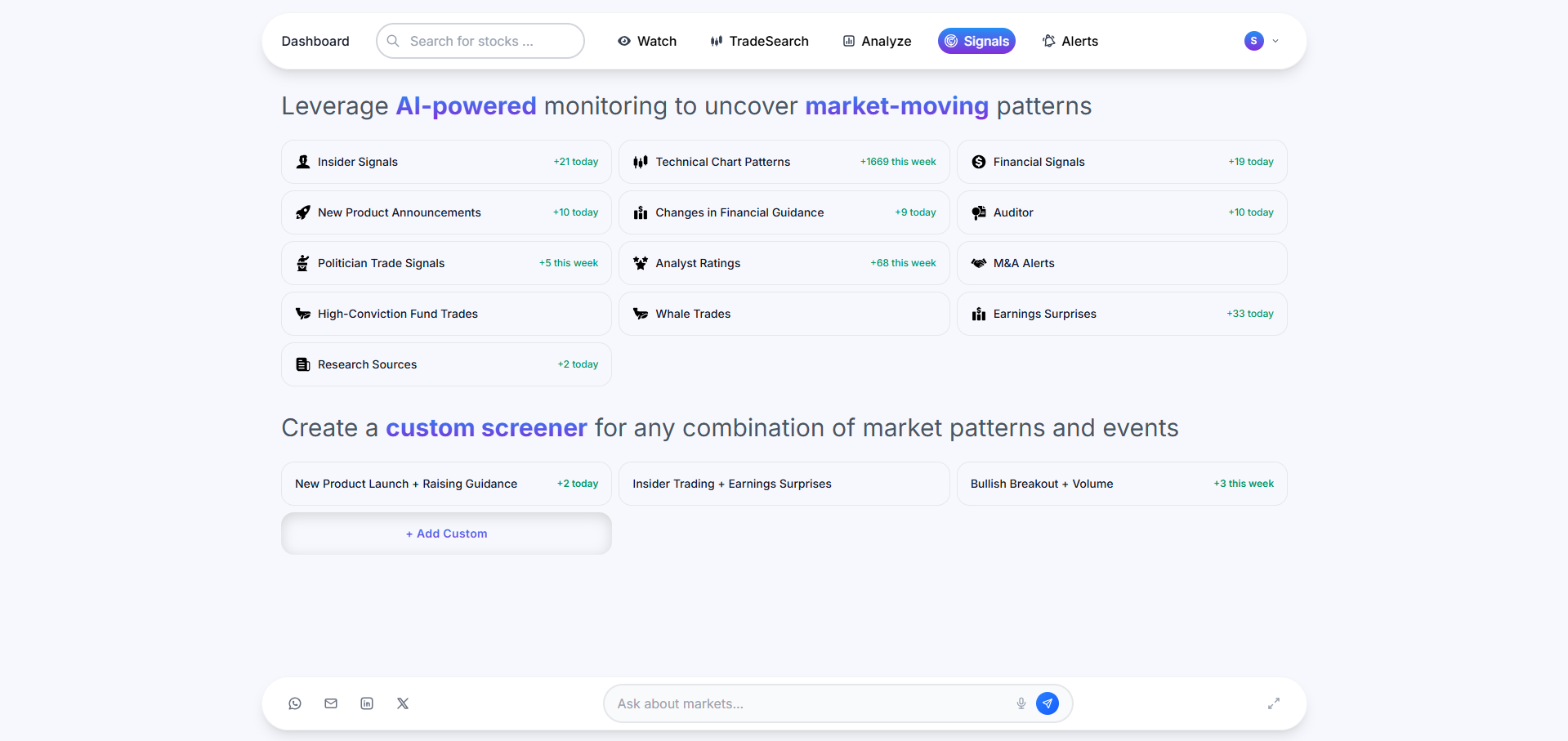
Step 3: Identify Actionable Stock Signals That Match Your Strategy
Stock signals are the core of any trading strategy. They represent the conditions under which a trade might be considered. AI helps identify these signals quickly and reliably, analyzing thousands of stocks simultaneously to detect patterns that match your strategy criteria.
Some common examples of AI-generated stock signals include:
Momentum breakouts: When a stock surpasses a resistance level accompanied by high volume.
Trend reversals: Indicators suggesting a stock may be changing direction, such as moving average crossovers.
Volume anomalies: Sudden spikes in trading volume that may precede significant price movements.
Event-driven catalysts: News releases, product launches, or regulatory approvals that can impact a stock’s trajectory.
For example, imagine AI identifies a stock forming an ascending triangle while volume spikes and an earnings report exceeds expectations. This combination of technical and fundamental stock signals generates a high-confidence smart trading alert. Once they receive it, traders can act quickly, adding the opportunity to their watchlist and preparing for potential entry points.
The magic of MarketAlerts lies in its reach: it tracks multiple stock signals (both technical and fundamental) simultaneously, helping you separate noise from actionable opportunities. This system ensures that trading alerts are meaningful, providing a clear basis for decision-making rather than overwhelming the trader with random fluctuations and countless notifications that create more confusion than anything else.
How to Setup Your Own Smart Trading Alerts: Watchlists, Smart Screeners & Stock Signals
You might be wondering how to translate the stock signals we have been talking about into a working strategy and actionable insights that uncover actual trading opportunities.
MarketAlerts offers a series of features you can use for exactly this. Let’s take a look at how exactly you can use them to define your trading strategy.
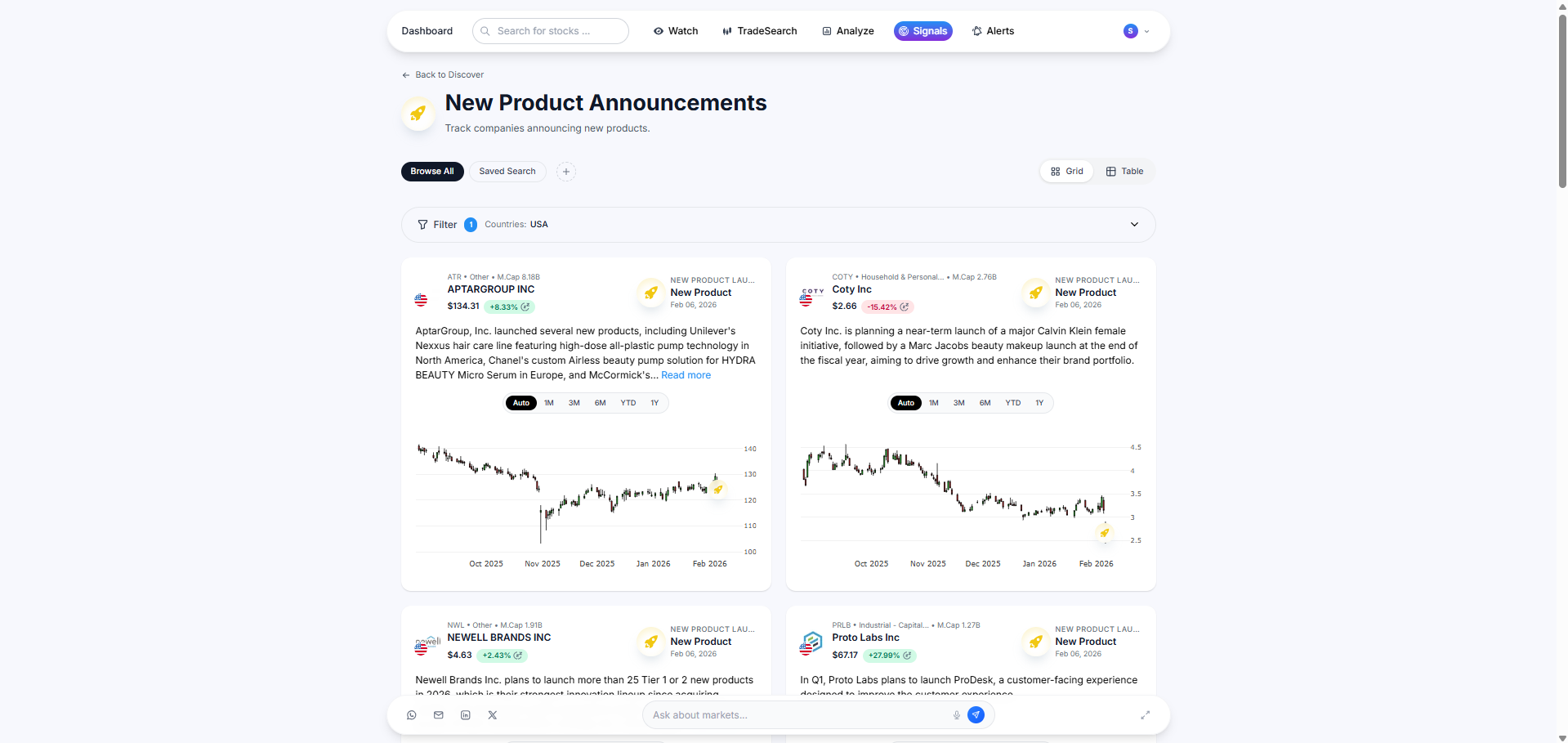
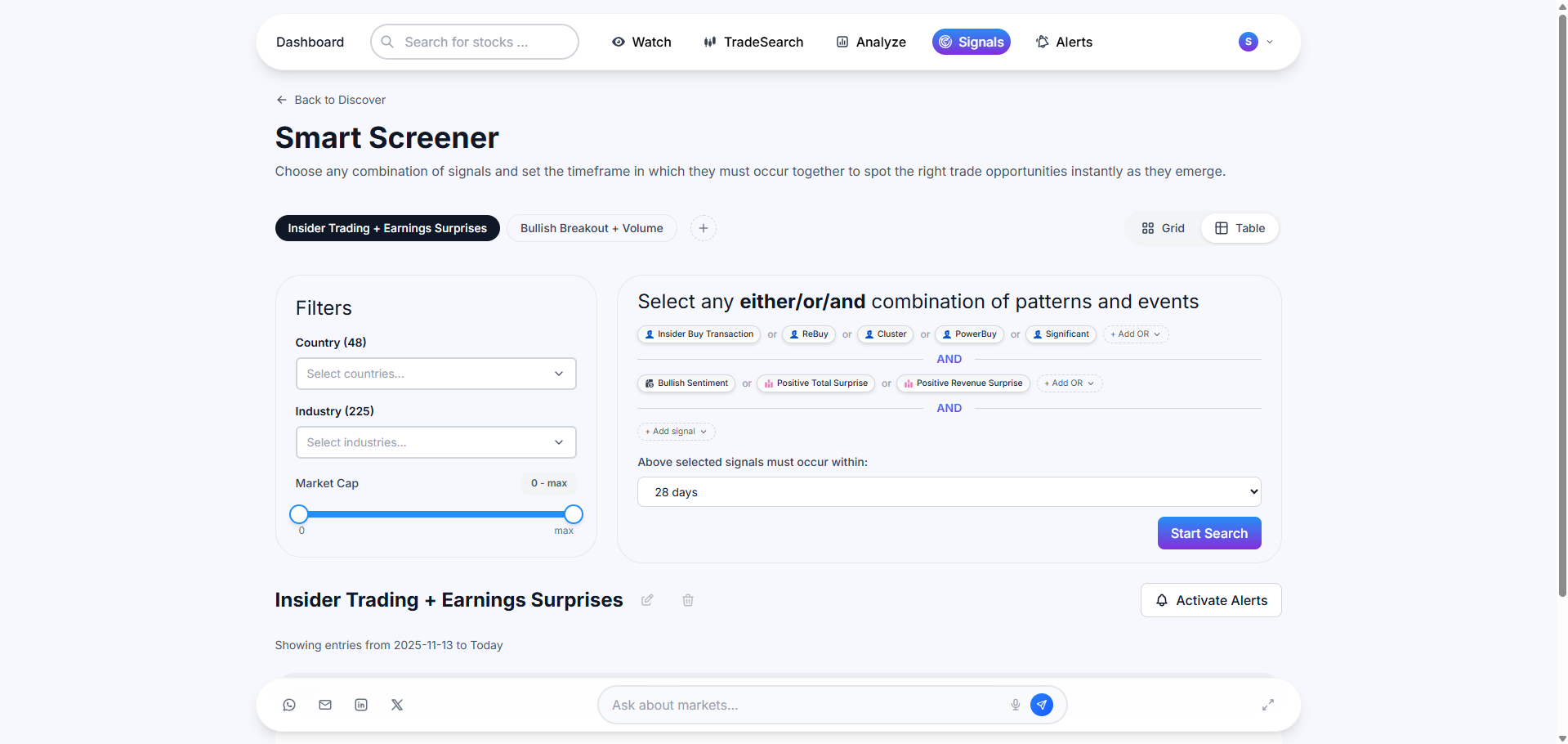
The Smart Screener is your central hub for systematically identifying high-probability trading opportunities. It allows you to define precise, rules-based criteria that reflect your unique strategy, whether it’s momentum trading, value investing, event-driven setups, or a combination of approaches.
You can filter stocks based on a wide range of factors, including:
Technical chart patterns: detect chart formations like breakouts, trend reversals, triangles, flags, and moving average crossovers.
Fundamental metrics: screen for strong revenue growth, margin expansion, earnings surprises, or valuation thresholds.
Insider and institutional activity: spot insider buying or significant institutional transactions that indicate conviction.
Analyst revisions: identify stocks with recent upgrades, downgrades, or target price changes.
Corporate events and news catalysts: track earnings releases, product launches, M&A activity, or regulatory approvals.
Unlike generic scanners, the Smart Screener continuously monitors thousands of securities in real time, applying your exact criteria across multiple dimensions simultaneously. This eliminates the need for manual chart reviews, spreadsheet tracking, or delayed analysis, ensuring that potential opportunities never slip through the cracks.
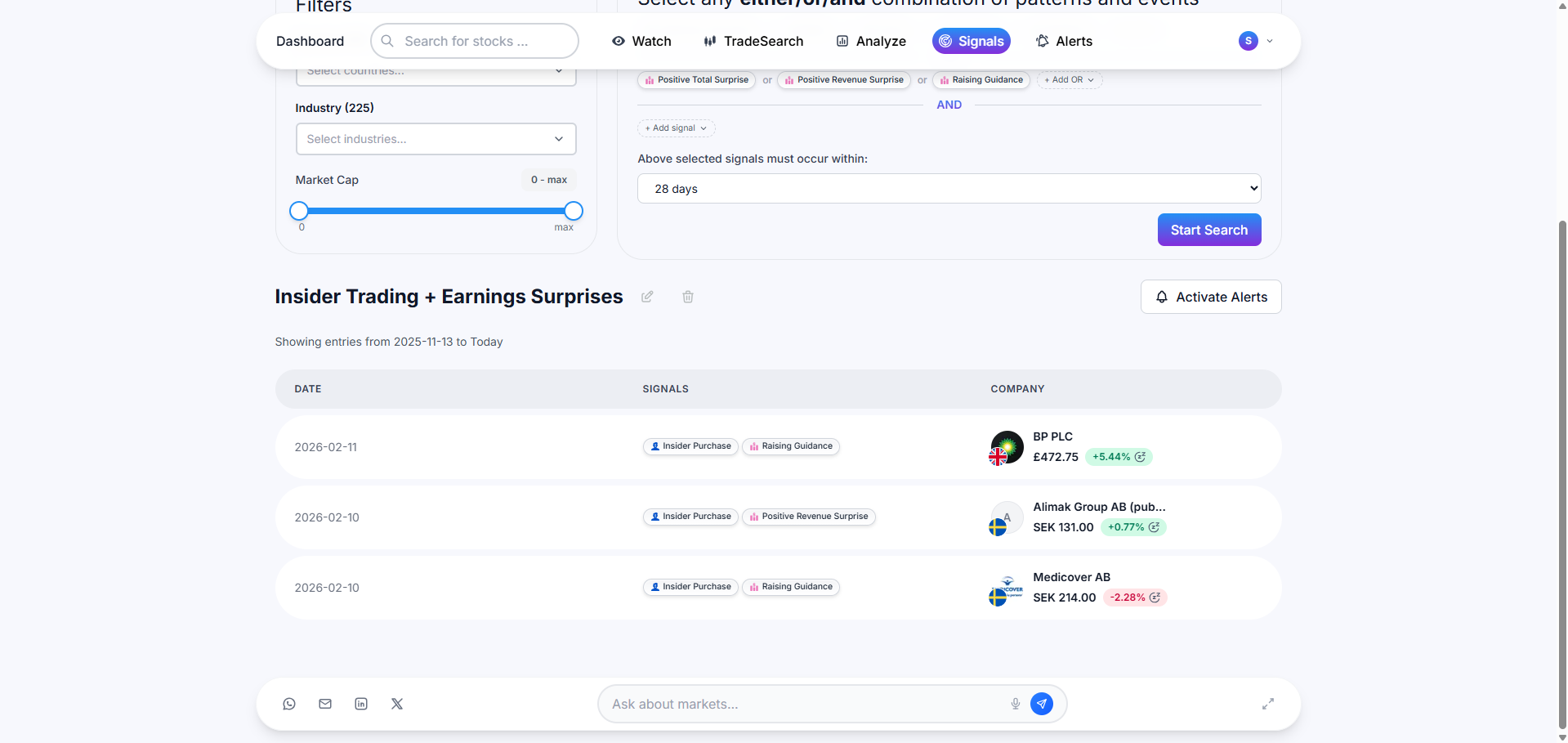
One of the best use cases for this feature is combining multiple filters to create sophisticated, multi-signal setups. For example, you could screen for stocks with a bullish technical pattern, positive earnings revision, and recent insider buying, all in one query.
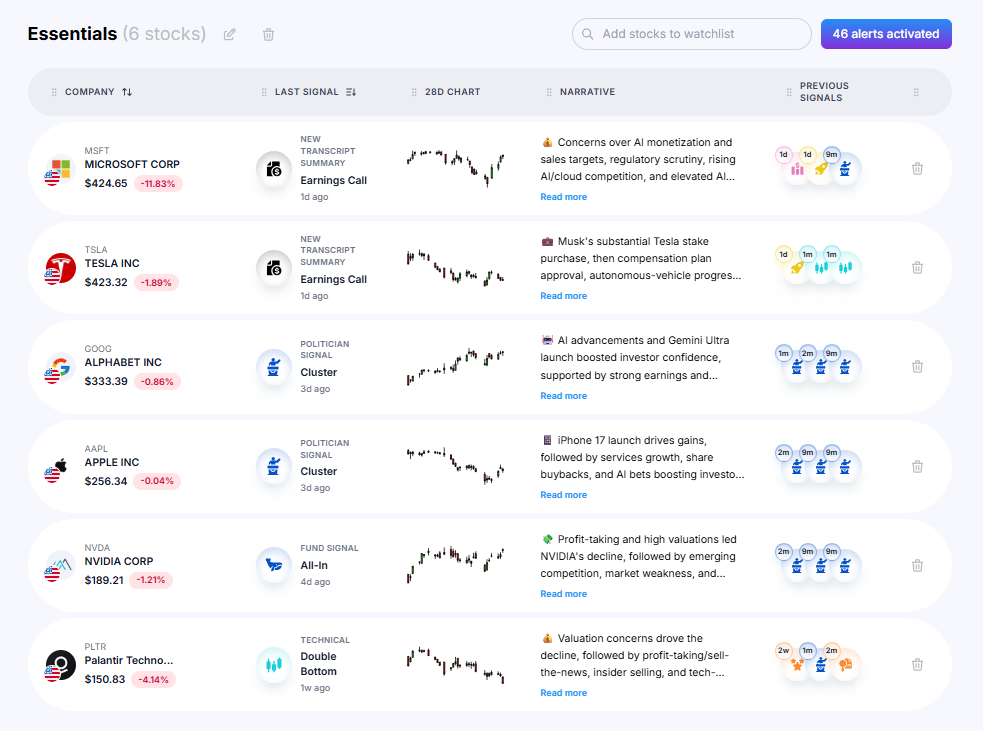
You can also go the other way around: instead of finding stocks based on signals, you can create stock watchlists and customize them to your preferences. These watchlists act as focused monitoring hubs, grouping securities by theme, strategy type, timeframe, or conviction level. This organization helps separate exploratory ideas from high-priority opportunities.
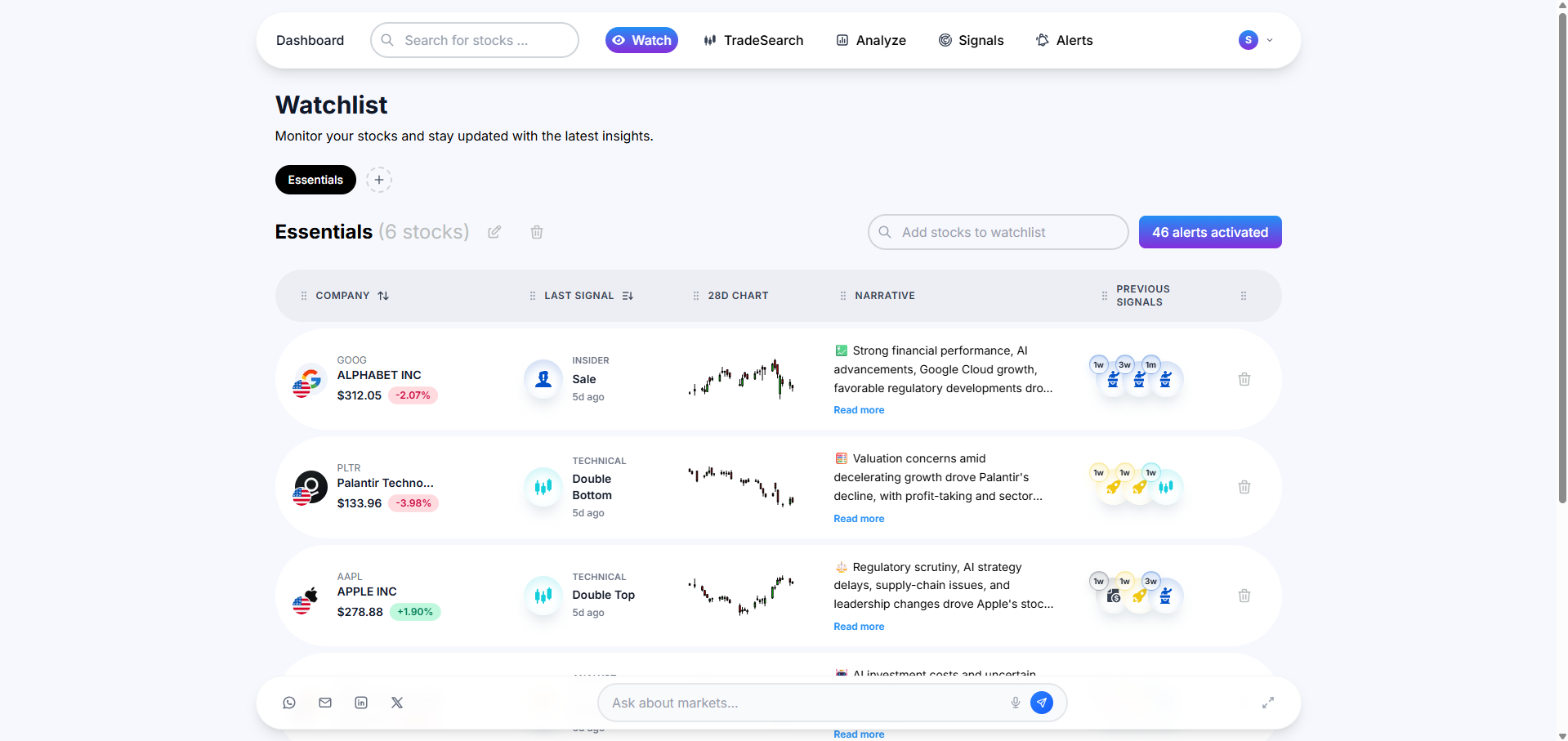
Regardless of what approach you choose (you can use both), smart trading alerts then complete the system. You can configure alerts based on specific technical triggers or combinations of stock signals, ensuring that notifications are aligned with your strategy. Trading alerts feed directly into a personalized dashboard, where signals are categorized by type, relevance, and timing.
As a result, you get a tailored stock market intelligence layer: a dashboard built around your strategy logic, packed with structured, actionable insights and strong investment candidates based on your preferences.
Step 4: Test and Refine Your Investment Strategy
Identifying stock signals and generating trading alerts is only the first step.
High-performing strategies require rigorous testing to determine what works under real market conditions. Backtesting allows you to simulate your AI-driven strategy using historical data, giving insight into potential outcomes, risks, and profitability.
AI accelerates this process by evaluating thousands of scenarios in minutes, identifying patterns that have historically produced positive results. For example, you can test how momentum breakouts perform across different sectors or how earnings-driven stock signals correlate with price movements.
Iterative refinement is crucial. Even the best AI models are sensitive to input criteria. Slight changes in the timing of trading alerts, the weight assigned to specific stock signals, or the types of chart patterns monitored can dramatically affect results. Consistent testing ensures that your AI-generated trading insights remain robust and aligned with your defined goals.
Refinement also includes understanding market context. Some signals work best in trending markets, while others excel in sideways or volatile conditions. AI investment tools can highlight these contextual nuances, allowing you to adapt your strategy dynamically.
This combination of testing and continuous refinement is what separates casual approaches from truly high-performing trading systems.
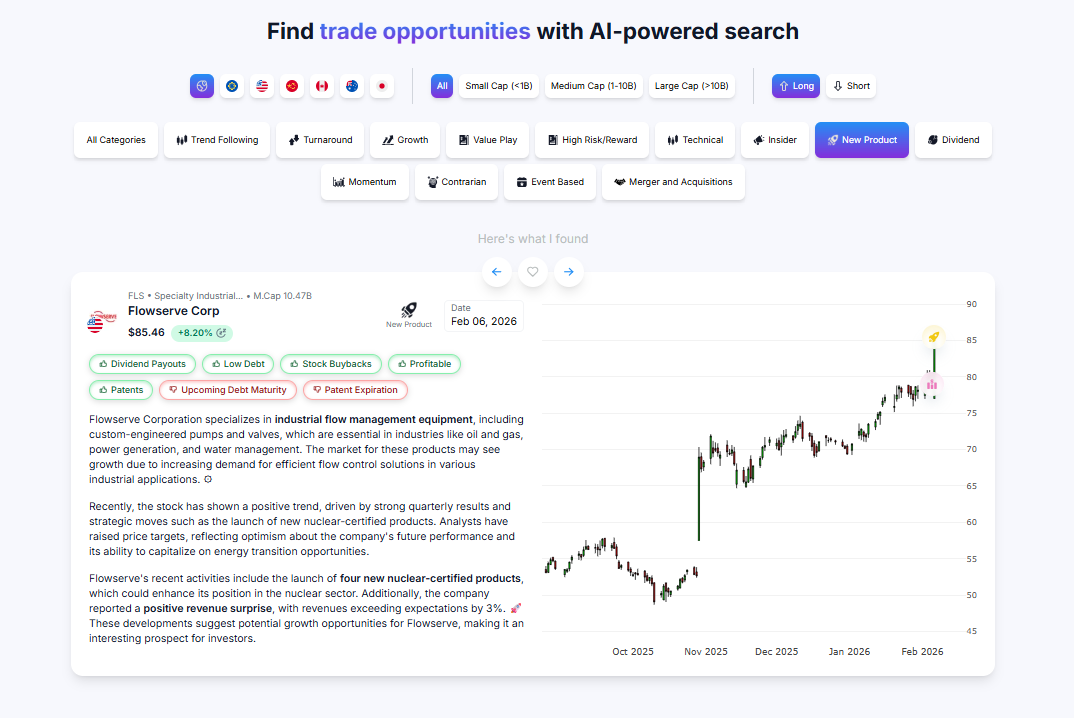
MarketAlerts provides unique StockStory charts that show you exactly how different signals and events affected the price. For each stock, the system actively gathers relevant information from multiple sources, processes it through specifically-trained AI models, and transforms it into clear, actionable insights, outlining potential scenarios and likely outcomes.
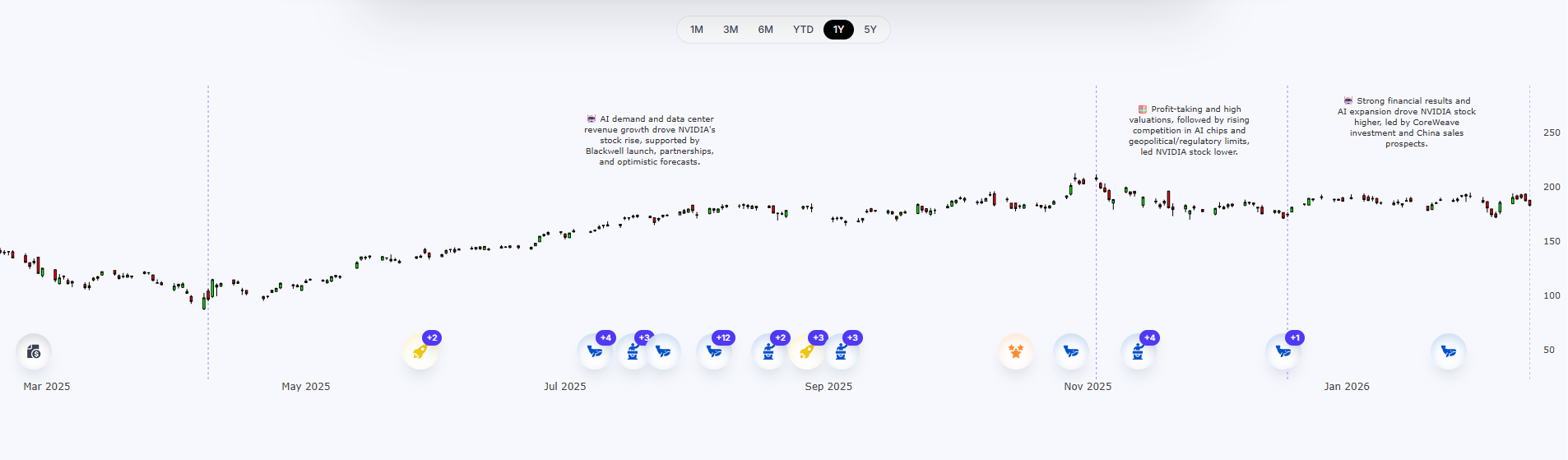
You can use these capabilities to study each stock and adjust parameters accordingly to refine your strategy for both accuracy and efficiency.
Step 5: Implement Real-Time Monitoring and Trading Alerts
The power of AI lies not only in analysis but also in action. Markets move fast, and opportunities often exist for only brief windows. Smart trading alerts based on stock signals ensure you are aware of potential moves as they happen, giving you the chance to respond quickly and efficiently.
Although often overlooked, setting up automated stock alerts for the conditions you’ve defined is a critical step to build high-performing trading strategies. For example, an AI system can notify you when a stock exhibits a combination of a breakout pattern, increased volume, and positive earnings, giving you a clear, actionable trading insight.
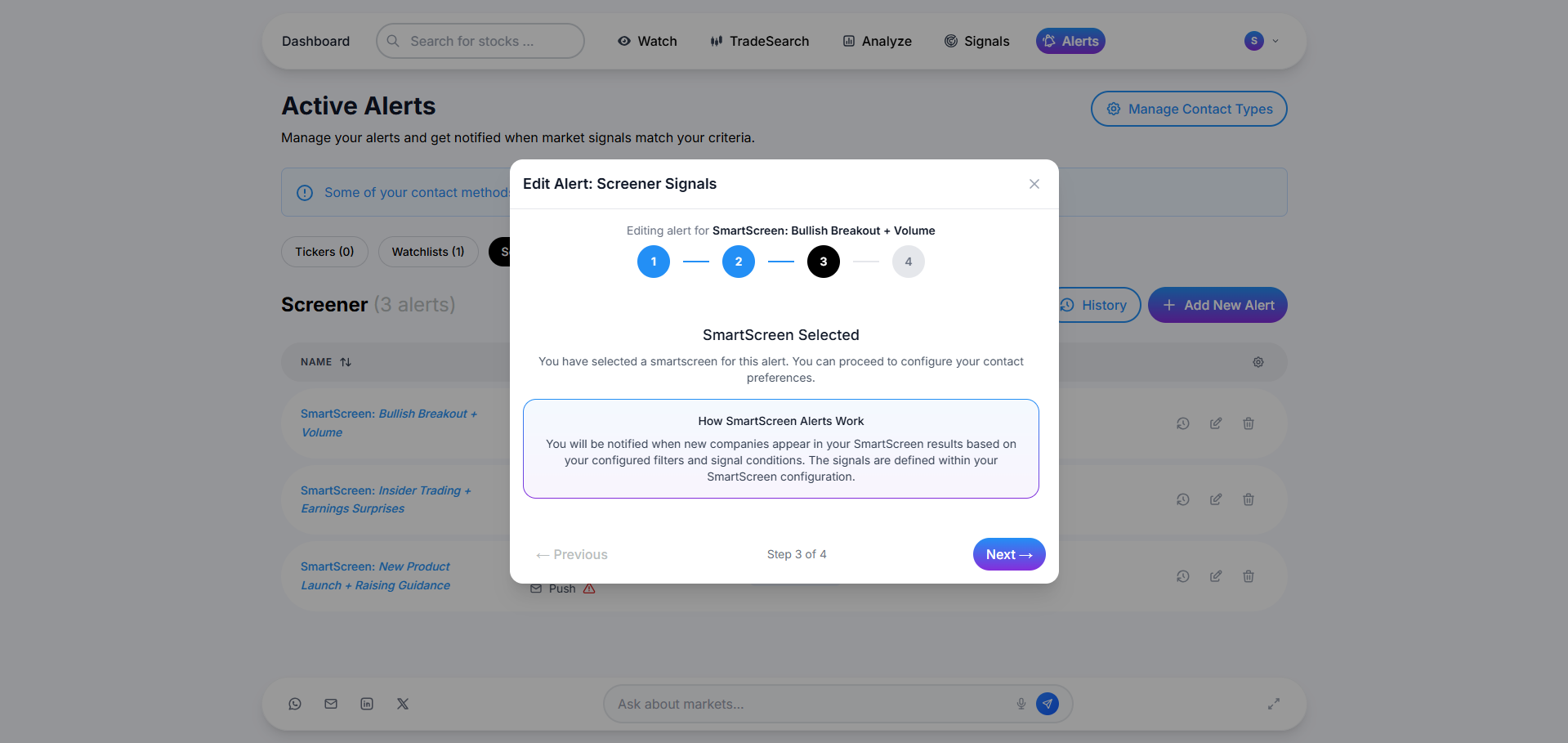
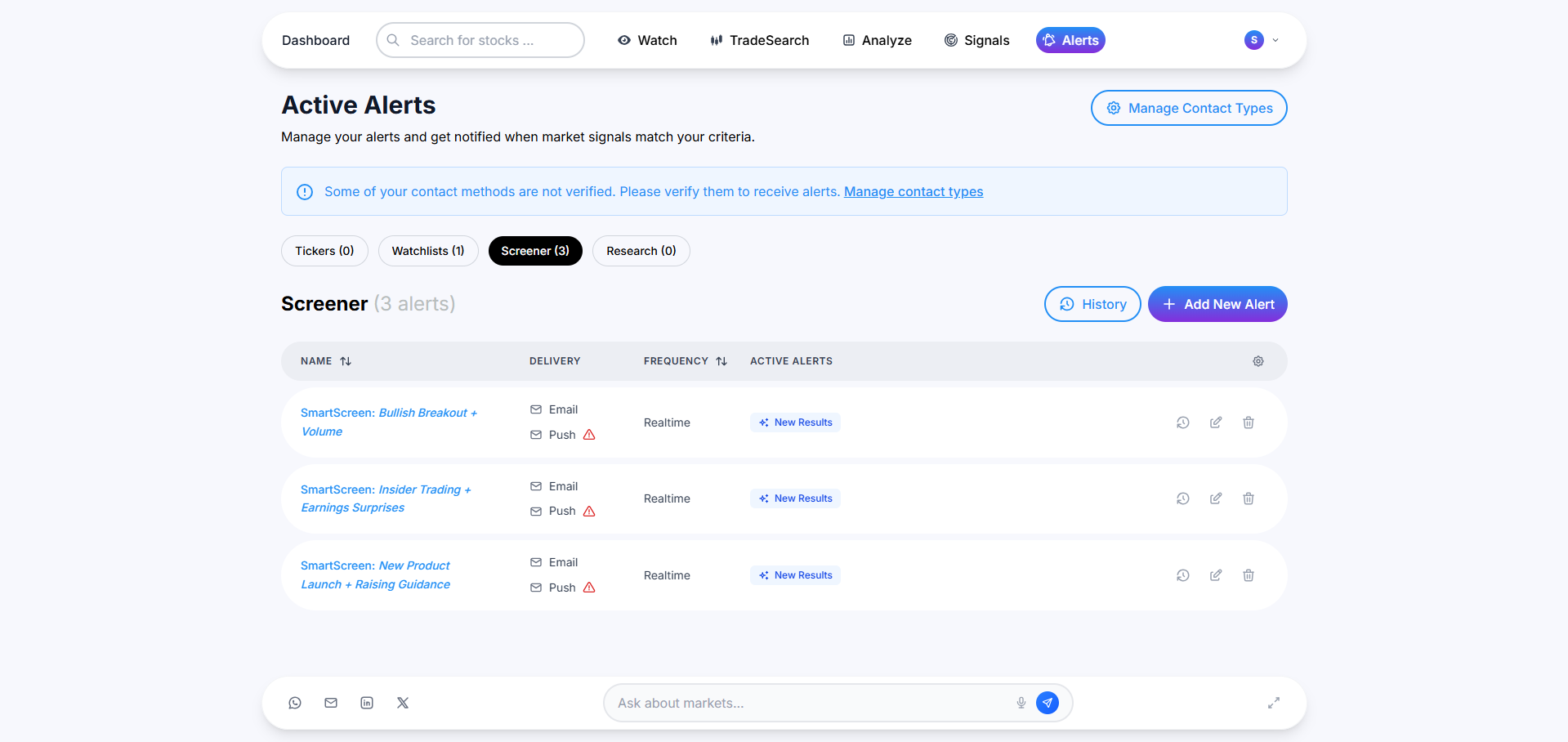
Real-time monitoring also allows you to manage risk more effectively. You can use AI to track price movements against your strategy thresholds, alerting you to potential reversals or changes in market conditions. This continuous feedback loop ensures that your strategy is not only proactive but also adaptive, reducing the likelihood of missed opportunities or unnecessary losses.
Step 6: Combine AI Insights with Human Judgment
This is extremely important. AI can process information at scale and detect subtle stock signals that humans might overlook, but it does not replace human judgment. The best investors use AI as a tool to inform decisions while applying experience, intuition, and context to evaluate opportunities.
For example, AI may generate a trading alert based on a strong technical chart pattern and earnings surprise, but understanding broader market conditions or company-specific developments can determine whether to act immediately or wait for confirmation.
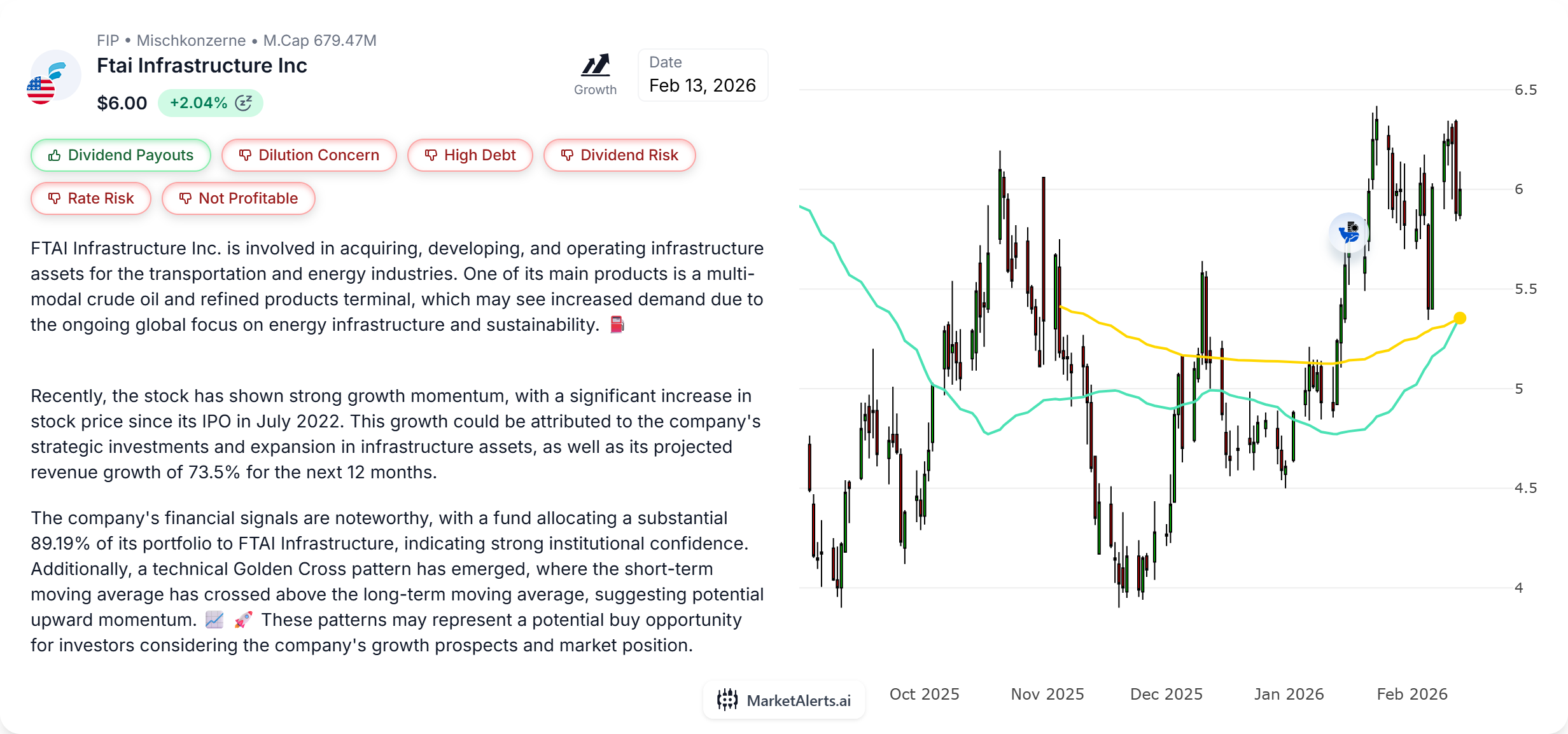
Combining AI insights with human judgment ensures that trading decisions are balanced, disciplined, and aligned with your investment objectives.
Over time, this combination improves your ability to interpret AI-generated trading insights, refine stock watchlists, and respond to evolving market conditions. Rather than reacting impulsively, you build a structured approach that turns data into actionable strategy.
Practical Tips for Building AI-Driven Trading Strategies
Even the most advanced AI tools only deliver results when they are applied with discipline and structure.
Building a high-performing system is about clarity, consistency, and continuous refinement. The following practical principles will help you translate AI capabilities into strategies that work in real market conditions:
Start simple: Begin with one or two types of stock signals before layering multiple indicators. This helps ensure clarity and reduces noise.
Prioritize high-quality alerts: Focus on trading alerts that combine technical, fundamental, and sentiment data for higher-confidence trade ideas.
Leverage watchlists: Use AI to maintain dynamic stock watchlists, tracking the signals most relevant to your strategy.
Review performance regularly: Assess which trading insights are delivering consistent results and adjust criteria as needed.
Integrate automation thoughtfully: Automate trading alerts and notifications to stay informed without being overwhelmed, but retain human oversight for execution.
Following these practical steps helps ensure that AI-driven strategies are not only theoretically sound but also actionable in live markets.

Closing Thoughts on How to Build High-Performing Trading Strategies With AI
Building high-performing trading strategies with AI is about combining speed, precision, and insight. AI allows you to analyze vast datasets, detect subtle stock signals, and generate smart trading alerts and insights; all in real time.
It’s important to remember that AI is not a replacement for skill or experience but a force multiplier, transforming complex market information into actionable knowledge. Investors who integrate AI-driven trading alerts and stock signals into a disciplined workflow gain a significant advantage, uncovering opportunities faster and making better-informed decisions.
Using these tools thoughtfully and systematically turns stock discovery and investing from guesswork into a structured, high-performing process, giving you the awareness and information you need to achieve consistent success in the stock market.
Invest smarter. Create your free MarketAlerts account and discover how to build high-performing trading strategies with AI.